
| Crop | Target | Dosage (per mu) | Application Method |
| Soybean Field | Annual weeds | 85-100 ml | Soil Spray |
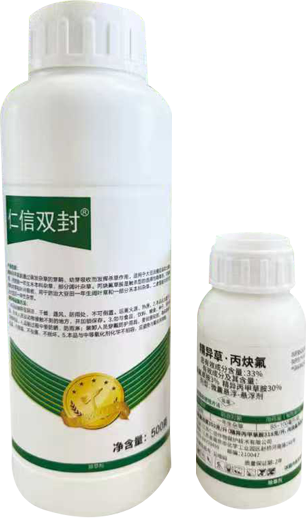
Renxin Shuangfeng? 33% S-metolachlor · Flumioxazin Microcapsule Suspension
This product is a compound formulation of two herbicides with different mechanisms of action and complementary spectrums, offering broadened weed control spectrum and synergistic effects. After soil surface application, the active ingredients are adsorbed by soil particles, forming a chemical barrier on the soil surface. When weeds germinate, contact of the coleoptile or young shoots with this barrier causes susceptible weeds to rapidly wilt and die.
Broad-Spectrum Control:? Effectively controls a wide range of common annual grasses and broadleaf weeds such as Crabgrass, Barnyardgrass, Green Foxtail, Goosegrass, Purslane, Redroot Pigweed, Ironplant, Lambsquarters, Pennsylvania Smartweed, Spiny Amaranth, Black Nightshade, Velvetleaf, Field Burweed, Dayflower, Eclipta, Beggarticks, Feather Cockscomb, Sesbania, etc.
Excellent Efficacy:? The upgraded microcapsule formulation of S-metolachlor and flumioxazin enhances weed control efficacy and crop safety. The effect is more persistent, providing more thorough and longer-lasting control.
Good Safety:? The advanced microcapsule suspension-suspension formulation reduces the risk of crop injury from leaching of active ingredients due to rain. It allows for effective control of release based on field conditions, enhancing crop safety.
Application Technical Requirements
Prepare the land meticulously: level, smooth, and finely harrowed. Shallow incorporation after application can ensure efficacy.
Strictly adhere to the recommended dosage. Use secondary dilution. Spray volume: 30-50 kg per mu. Ensure uniform and thorough coverage without misses or overlaps. Apply as soon as possible after sowing, generally within 3 days. Shallow incorporation after application can ensure efficacy. Do not overdose. Do not apply when crops are emerging or at the seedling stage. Avoid application before heavy rain. Prevent spray drift to adjacent sensitive crops to avoid injury.
Soil moisture significantly impacts efficacy. Moderate moisture is ideal; dry soil reduces effectiveness—consider using the higher recommended dose and increase spray volume to 45-60 kg per mu. Low-lying, waterlogged fields are prone to injury. In areas with frequent rain after application, direct-seeded crops can use ridge-till and plastic mulching to mitigate or avoid injury.
Heavy irrigation or moderate-to-heavy rainfall after application may cause slight phytotoxicity or affect efficacy in some crops, but recovery is usually rapid and generally does not affect later growth or yield. If injury occurs, timely application of brassinolide etc., after the seedling cotyledons emerge and expand, can promote rapid recovery.
In summer soybean areas rotating with wheat, this product is ineffective against volunteer wheat. For fields dominated by broadleaf weeds, consider tank-mixing with fluoroglycofen or bentazon based on the weed spectrum.
The flumioxazin component carries a certain risk of phytotoxicity to cotton, depending on tank-mix partners, cotton variety, temperature, humidity, etc. Exercise caution during field application.
